What are Amblypygi?

Amblypygi are one of those creatures that look terrifying at first glance but turn out to be surprisingly gentle once you get to know them. They sit in a fascinating corner of the arachnid world, and their appearance alone is enough to spark curiosity.

What Amblypygi are

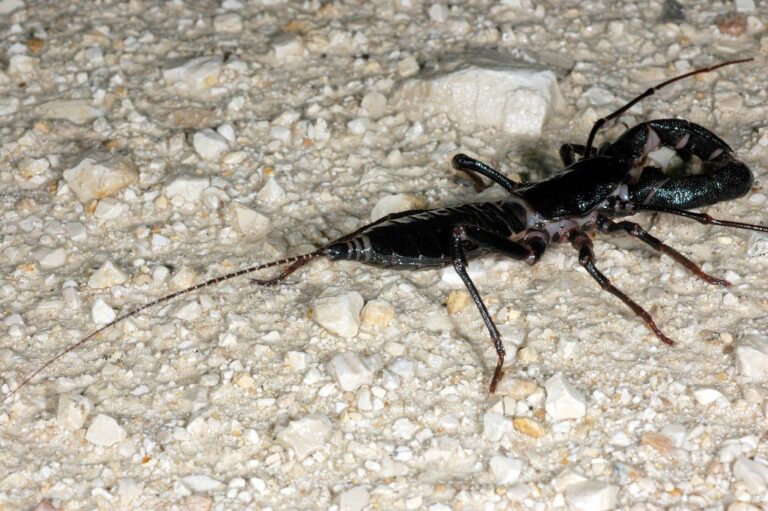
Amblypygi—often called tailless whip spiders or whip scorpions—belong to the class Arachnida, but they are neither true spiders nor scorpions. Their bodies are flat, their pedipalps form spiny grasping “arms,” and their extremely long, thin front legs act like antennae for sensing their surroundings. They walk sideways like crabs and look like a mashup of several arachnids.

They’re an ancient group too: fossils show they’ve existed since the Carboniferous period, over 350 million years ago.

Lifestyle and Behavior

Amblypygi are nocturnal, shy, and light‑avoiding creatures. They spend their days hiding in:

  • Tree bark crevices
  • Rock cracks
  • Caves
  • Leaf litter

They’re found mostly in tropical regions, but some species live in Mediterranean and desert areas as well.

Their flattened bodies help them squeeze into tight spaces, and their long sensory legs allow them to “feel” the world around them. They move slowly most of the time but can dart away with surprising speed when startled or when hunting.

Are They Dangerous?

Despite their intimidating appearance, Amblypygi are completely harmless to humans. They:

  • Have no venom glands
  • Cannot sting
  • Rarely attempt to pinch unless severely provoked

Their fearsome look has given rise to myths—such as the idea that their bite can kill in 24 hours—but these are just legends. In reality, they’re gentle, skittish animals that prefer to flee rather than fight.
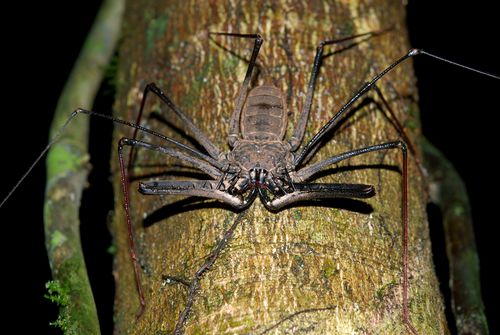
an amblypygi on a tree

You may also like to know what is a vinegaroon : What Is a Vinegaroon? (Facts, Appearance & Is It Dangerous?)

Our learning resources

Similar Posts

  • What are stingless bees?

    What are stingless bees? stingless bees are a fascinating group, and they’re very different from the honeybees most people know. They open the door to some really interesting discussions about behavior, ecology, and even exotic animal keeping. Stingless bees belong mainly to the tribe Meliponini (in the tropics) and some species of Trigona. Despite the…

  • What Is a Lithobie?

    What Is a Lithobie? A lithobie is a small, fast-moving myriapod belonging to the class Chilopoda, the group commonly known as centipedes. More specifically, it refers to species within the genus Lithobius, a widespread and diverse group of arthropods found across Europe and many other regions. The name comes from the Greek lithos (“stone”) and…

  • What is the brazilian wandering spider?

    What is the brazilian wandering spider? The Brazilian wandering spider is one of the most venomous and aggressive spiders on Earth, known for roaming the forest floor at night instead of building webs. It belongs to the genus Phoneutria, whose name literally means “murderess,” and includes several species found across South America. What it is…

  • What are Mealybugs?

    What are Mealybugs? Mealybugs are small, soft‑bodied insects that feed on plant sap and are considered major agricultural and horticultural pests. They weaken plants, produce sticky honeydew that leads to mold growth, and can even spread plant diseases. Their “role” in ecosystems is mostly as pests, though they also participate in food webs and mutualistic…

  • What are Heteropoda davidbowie?

    What are Heteropoda davidbowie? Heteropoda davidbowie, or David Bowie’s golden spider, is a species of arachnomorph spider belonging to the Sparassidae family. Origin & Habitat They are native to Malaysia, Singapore, and Sumatra. They lives in tropical forests, often hiding under bark, leaves, or crevices. This species was first described in 2008 by arachnologist Peter…

  • What Is an Antlion?

    What Is an Antlion? An antlion (French: fourmilion) is a neuropteran insect belonging to the family Myrmeleontidae, best known for its larvae, which dig funnel‑shaped pits in loose sand to trap ants. With more than 1,500 species worldwide, antlions are widespread in warm, dry environments, including parts of central Europe. Although the adult resembles a…