What is a vinegaroon?
A vinegaroon, also called a whip scorpion—is a harmless arachnid that looks intimidating but poses no real danger to humans. Most species live several years, typically between 5 and 9 years depending on the source.
What a Vinegaroon Is
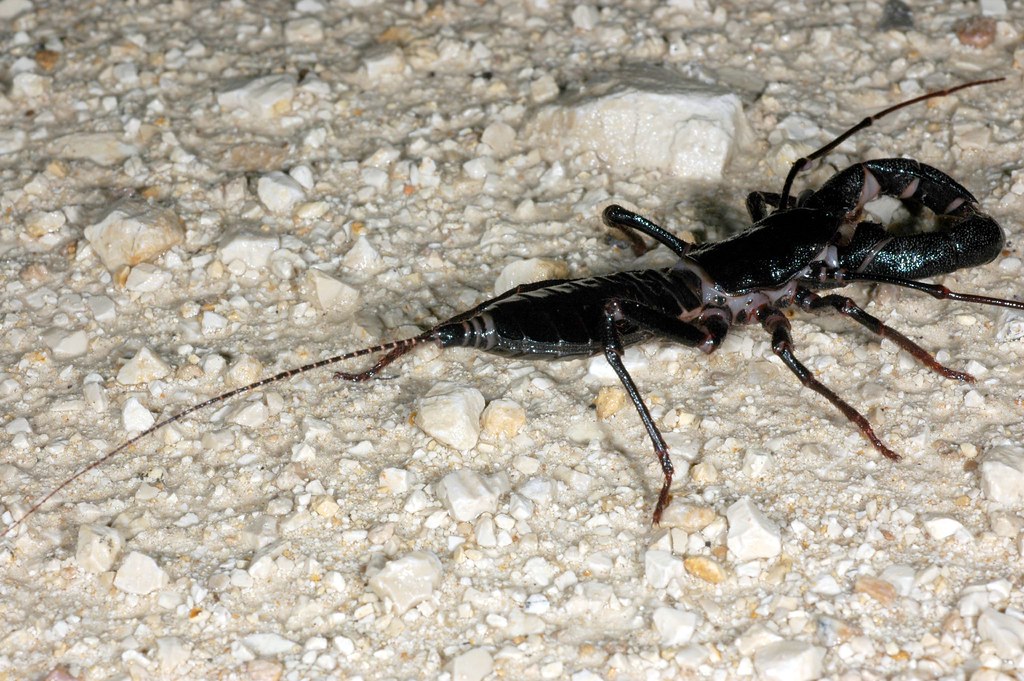
A vinegaroon is an arachnid belonging to the order Uropygi (also called Thelyphonida). It gets its name from its ability to spray a vinegar‑smelling acetic acid when threatened. They have a whip‑like tail, large pedipalps (pincer-like limbs), and a flattened body.
Is it dangerous?
Not dangerous to humans. A vinegaroon cannot sting (unlike true scorpions) and do not have venom. Their only defense is spraying a mild acid that smells like vinegar—unpleasant but not harmful.
Lifespan
Different sources give slightly different ranges:
- Up to 5 years according to some wildlife references.
- 7 to 9 years according to other animal fact sources.
- A reasonable estimate is 5–9 years, depending on species and environment.
Birth
The female lays around 10 to 40 eggs per clutch. After the incubation period, the young hatch from their eggs and, still completely white, climb onto their mother’s back, much like scorpions. After around two weeks, the young molt for the first time, and after less than two more weeks, they molt a second time. They then look like miniature adults. A few days later, when their shells have hardened, the young climb down from their mother’s back and begin to explore the burrow, gradually leaving the nest within a few days. Unfortunately, many will not reach adulthood due to predators.
Defensive glands
Although the uropygi resembles a scorpion, it does not have venom glands but rather anal glands that are unique to it. These glands can propel fine droplets of repellent that actually contain acetic, octanoic, formic, or chlorinated acid. It can spray this liquid about 30 centimeters and is often used to disrupt the vision of predators and is particularly effective. For humans, it is completely harmless
Extra Facts
Size ranges from 25–85 mm (1–3.3 inches). Diet includes insects, millipedes, slugs, worms, and small arthropods. They live in tropical and subtropical regions worldwide.
In scientific classification, the uropygid is an arachnid belonging to the order Uropygi, which contains only one family, known as Thelyphonidae. This family comprises several subfamilies and approximately 23 genera, containing a total of more than 110 species.
You may also like to know what is a camel spider : What Is a Camel Spider? (Size, Myths & Is It Dangerous?)
Our learning resources
- Our Gumroad shop : https://arthropodinfo.gumroad.com/
- Dangerousness of arachnids ebook : https://arthropodinfo.gumroad.com/l/dangerousness-of-arachnids