Why do spiders eat their mates?

Some spiders eat their mates because it boosts the female’s reproductive success and, in some species, even increases the male’s chances of passing on his genes. It’s an evolved strategy called sexual cannibalism, and while it sounds brutal, it’s surprisingly logical from an evolutionary perspective.

Why This Happens

  • Nutritional boost for the female: A male spider’s body provides a high‑value meal. Well‑fed females often produce more eggs and healthier offspring.
  • Sexual conflict: Males want to mate as much as possible; females want the best genes and resources. Cannibalism can be a way for females to control mating opportunities and maximize their own fitness.
  • Size differences: In many species, females are much larger than males. This size gap makes males easy prey and increases the likelihood of cannibalism.
  • “Aggressive spillover”: Some females are naturally aggressive hunters. That aggression can “spill over” into mating encounters, leading to cannibalism even when it’s not strictly necessary.

Not all spiders do it.

Despite the stereotype (thanks, black widows), most spider species do not regularly eat their mates. In some species, males even sacrifice themselves because it increases the chance that the female uses their sperm.
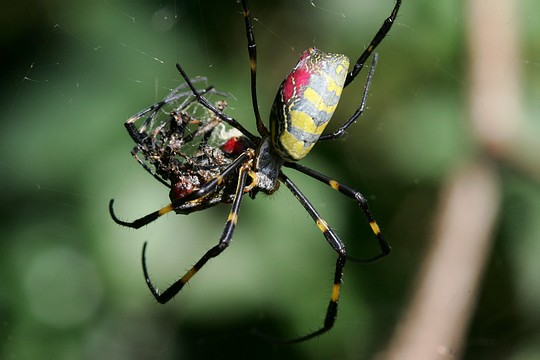
image showing that spiders eat their mates sometimes

You may also like to know why arachnophobia is so common : Why is arachnophobia so common? (the various factors)

Our learning resources

Similar Posts

  • Why do some insects glow?

    Why do some insects glow? Bioluminescence is the ability of living organisms to produce visible light through internal chemical reactions. Many insects—especially fireflies, glow‑worms, and click beetles—use this ability for communication, survival, and reproduction. Biological Reasons Fireflies use species‑specific flash patterns to attract mates. Each species has its own “flash language,” helping males and females…

  • How do spiders make webs?

    How do spiders make webs? Spiders build webs through a remarkably precise, instinctive process using silk they produce from specialized organs called spinnerets. The whole operation is a mix of engineering, biology, and behavior that varies slightly by species, but the core steps are surprisingly consistent. How Web‑Building Works Silk Production Creating the First Anchor…

  • Why is arachnophobia so common?

    Why is arachnophobia so common? Arachnophobia is so common because humans seem to be wired—biologically, culturally, and cognitively—to overreact to spiders, even though most species pose no real danger. Evolutionary instincts, learned behavior, and the way our brains process “creepy” movement patterns all contribute to this widespread fear. Evolutionary predisposition Early humans who quickly avoided…

  • Why do insects like light?

    Why do insects like light? Many insects appear to “like” light because artificial lights disrupt the way they naturally navigate at night. Most nocturnal insects evolved to use the moon or stars as stable reference points, and bright human-made lights confuse those systems, pulling them off course. Why insects gather around lights Disrupted night‑time navigation:…

  • Why crickets sing?

    Why crickets sing? Crickets have the distinctive trait of “singing.” They do this particularly in the evening and during part of the night for a variety of reasons. Male crickets sing for communication, and most of all, for romance. Their chirps serve several purposes : How do they produce their sound? Crickets don’t have vocal…

  • How do ants communicate?

    How do ants communicate? Ants have a surprisingly sophisticated communication system, and it’s one of the big reasons their colonies function like well‑oiled machines. Their “language” isn’t spoken — it’s chemical, tactile, and sometimes even vibrational. Chemical Signals (Pheromones) This is the primary way ants share information. Touch & Antennae Taps Ants also communicate by…