Do tarantulas recognize their owner?

Tarantulas don’t have the kind of brain structure needed for forming social bonds or recognizing individual humans. They’re solitary animals with very simple nervous systems, and their behavior is driven almost entirely by instinct rather than learning who you are. That said, there are a few interesting nuances that keep the topic from being a simple “no”.

What tarantulas can perceive

  • Vibrations: They’re extremely sensitive to movement and ground vibrations. Over time, a tarantula may become less reactive to the typical vibrations you make when opening its enclosure or doing maintenance.
  • Routine: They can adapt to predictable patterns. A tarantula that is regularly fed or handled in a calm, consistent way may appear more relaxed.
  • Scent & vision: Their eyesight is poor, and they don’t use scent to identify humans.

What they cannot do

  • They don’t recognize faces or voices.
  • They don’t form emotional bonds.
  • They don’t distinguish one human from another as individuals.

Why some keepers feel their tarantula “knows” them

This is usually:

  • Habituation (getting used to non-threatening stimuli)
  • Reduced defensive behavior due to consistent, gentle care
  • Keeper interpretation — we’re social animals, so we naturally project social meaning onto behavior

The bottom line

Your tarantula doesn’t recognize you, but it can become accustomed to your presence and behave more calmly because of that. In captivity, that’s about as close as it gets.
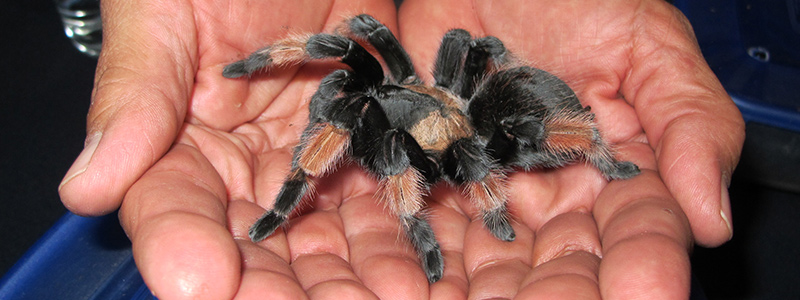
handling a brachypelma to see if tarantulas recognize their owner

You may also like to know if human body can build immunity to spider’s venom : Can You Build Immunity to Spider Venom? (Science Explained)

Our learning resources

Similar Posts

  • Why do some insects glow?

    Why do some insects glow? Bioluminescence is the ability of living organisms to produce visible light through internal chemical reactions. Many insects—especially fireflies, glow‑worms, and click beetles—use this ability for communication, survival, and reproduction. Biological Reasons Fireflies use species‑specific flash patterns to attract mates. Each species has its own “flash language,” helping males and females…

  • How do ants communicate?

    How do ants communicate? Ants have a surprisingly sophisticated communication system, and it’s one of the big reasons their colonies function like well‑oiled machines. Their “language” isn’t spoken — it’s chemical, tactile, and sometimes even vibrational. Chemical Signals (Pheromones) This is the primary way ants share information. Touch & Antennae Taps Ants also communicate by…

  • Why do spiders eat their mates?

    Why do spiders eat their mates? Some spiders eat their mates because it boosts the female’s reproductive success and, in some species, even increases the male’s chances of passing on his genes. It’s an evolved strategy called sexual cannibalism, and while it sounds brutal, it’s surprisingly logical from an evolutionary perspective. Why This Happens Not…

  • Why is arachnophobia so common?

    Why is arachnophobia so common? Arachnophobia is so common because humans seem to be wired—biologically, culturally, and cognitively—to overreact to spiders, even though most species pose no real danger. Evolutionary instincts, learned behavior, and the way our brains process “creepy” movement patterns all contribute to this widespread fear. Evolutionary predisposition Early humans who quickly avoided…

  • How do bees communicate?

    How do bees communicate? Bees communicate through a remarkably rich language made of movement, scent, and vibration, allowing them to coordinate foraging and hive survival with precision. Their most iconic behavior—the waggle dance—lets them share exact directions to food sources, while pheromones and vibrations help maintain order and signal danger. Key Communication Methods The Waggle…