What Are Dwarf Tarantulas?
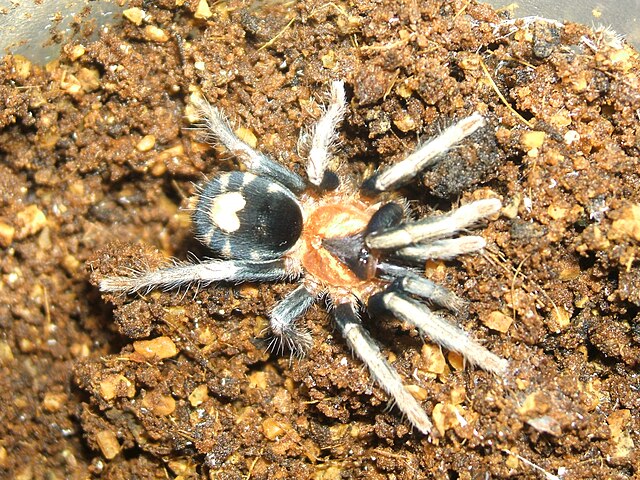
The term dwarf tarantula refers to tarantula species that remain very small as adults — typically under 4 inches (10 cm) in leg span. There is also a specific family called Mecicobothriidae, known as dwarf tarantulas in the scientific sense. These spiders look like tiny tarantulas and are often 1–2 cm in body length.
So the term can mean two things :
- Hobby term -> Any tarantula species that stays under ~10 cm leg.
- Scientific term -> Members of the family Mecicobothriidae, extremely small mygalomorph spiders (1–2 cm).
Why Are They “Dwarf”?
Dwarf tarantulas evolved small size due to ecological pressures such as:
- Microhabitat specialization — leaf litter, mossy forest floors, tight burrows.
- Reduced predation pressure in tiny, hidden environments.
- Resource efficiency — small bodies require less food and allow faster maturity.
In the case of the Mecicobothriidae, their tiny size is simply an ancient evolutionary lineage of small mygalomorph spiders.
How Does Small Size Affect Their Lifestyle?
Their size shapes almost everything about how they live:
- Habitat Use: They occupy very small burrows, cracks, or leaf litter. Many build sheet-like webs or funnel structures (especially Mecicobothriidae).
- Behavior: They tend to be fast-growing compared to larger tarantulas. Often more secretive and spend time hidden. Some species are surprisingly bold despite their size.
- Diet: They hunt tiny prey: micro-crickets, small roaches, springtails. Their feeding response can be extremely fast.
- Reproduction: Smaller species often mature sooner. They may produce smaller egg sacs, but sometimes more frequently.
- Captive Care: They require compact enclosures, making them ideal for keepers with limited space. Humidity and ventilation must be balanced carefully because small enclosures fluctuate quickly.
Examples of Dwarf Tarantula Species
From the hobby (under ~10 cm leg span):
- Cyriocosmus elegans — Trinidad Dwarf Tarantula
- Cyriocosmus aueri
- Cyriocosmus ritae
- Cyriocosmus giganteus (still small despite the name)
- Avicularia minatrix — a tiny arboreal species
- Homoeomma chilensis — Chilean dwarf species
- Ami sp. species (various small New World terrestrials)
Scientific dwarf tarantulas (family Mecicobothriidae):
- Mecicobothrium thorelli
- Mecicobothrium sp. (various species)
Our learning resources
- Our Gumroad shop : https://arthropodinfo.gumroad.com/
- Dangerousness of arachnids ebook : https://arthropodinfo.gumroad.com/l/dangerousness-of-arachnids