What is a camel spider?
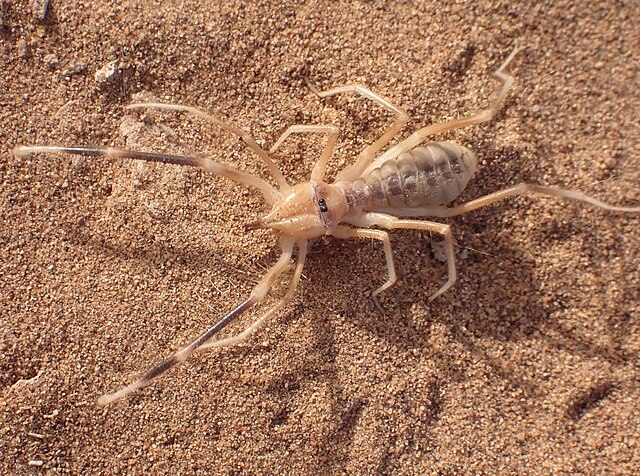
A solifuge—often called a camel spider, wind scorpion, or sun spider—is a member of the order Solifugae, a group of fast‑moving arachnids found mostly in warm, arid regions. Despite the dramatic nicknames, they are not true spiders and not scorpions. They form their own distinct lineage, recognizable by their oversized jaws, incredible speed, and surprisingly expressive behavior.
What a Solifuge (Camel Spider) Actually Is
Solifuges belong to the order Solifugae, a group of arachnids distinct from both spiders and scorpions. They are also called sun spiders, wind scorpions, or camel spiders. Over 1,000 species exist worldwide, mostly in dry or desert climates.
Solifuges are characterized by:
- Large chelicerae (jaw-like appendages) capable of powerful bites used for hunting and defense
- Ten legs at first glance, though only eight are true legs; the front pair act like sensory feelers
- Extreme speed, sometimes reaching around 16 km/h, which is astonishing for their size
- No venom, despite persistent myths
- No silk production, so they don’t spin webs
They are voracious predators, feeding on insects, small lizards, and even other arachnids. Their hunting style is active and aggressive, relying on speed and strong jaws rather than venom.
Lifespan and Life Cycle
Solifuges have relatively short lives, especially compared to other arachnids.
Their typical lifespan is 1 to 2 years in the wild. Some species may live slightly longer in captivity, though they are notoriously difficult to keep due to their stress sensitivity and high activity levels.
Life stages:
- Eggs – Laid in burrows dug by the female
- Post‑embryo – A transitional stage before becoming mobile
- Nymphal instars – Several molts as they grow
- Adult – Reproductive stage, often the shortest part of their life
Females generally live longer than males, as males often die shortly after mating.
Behavior and Ecology
Solifuges are solitary, nocturnal hunters. They spend the day hiding in burrows or under rocks to avoid heat and predators. At night, they roam widely in search of prey.
Some notable behaviors:
- Burrow digging: They can excavate surprisingly deep burrows using their jaws and legs.
- Photophobia: They avoid light, which is why they sometimes appear to “chase” people—the animal is actually fleeing your shadow.
- High metabolism: They must eat frequently, which fuels their speed and activity.
Legends, Myths, and Cultural Perceptions
Solifuges have inspired a remarkable amount of folklore, especially in desert cultures. Their dramatic appearance and speed make them easy subjects for exaggeration.
Common myths:
- “They scream.” They don’t. Some species can make faint stridulation sounds by rubbing body parts together, but nothing like a scream.
- “They can run as fast as a human.” They’re fast for their size, but nowhere near human running speed.
- “They are venomous.” Completely false. Their bite can be painful due to strong jaws, but they have no venom glands.
- “They eat camels or humans.” This myth exploded during the Iraq War, where viral photos made them appear enormous due to forced perspective. In reality, they are typically 5–7 cm, with some species reaching 12–15 cm including legs.
In some regions, solifuges are seen as:
- Symbols of the desert’s harshness
- Creatures of bad luck
- Natural pest controllers, since they eat scorpions and insects
Their dramatic appearance has also made them popular in internet lore, where they’re often portrayed as monstrous or dangerous—an image far removed from their actual behavior.
Why They Fascinate Us
Solifuges sit at the intersection of fear and fascination. They look alien, move with startling speed, and defy easy categorization. Yet they are ecologically important predators and, in many ways, quite delicate creatures.
In summary, camel spiders are animals that remain fragile and harmless to humans despite their appearance, which can be intimidating.
You may also like to know what is a vinegaroon : What Is a Vinegaroon? (Facts, Appearance & Is It Dangerous?)
Our learning resources
- Our Gumroad shop : https://arthropodinfo.gumroad.com/
- Dangerousness of arachnids ebook : https://arthropodinfo.gumroad.com/l/dangerousness-of-arachnids